

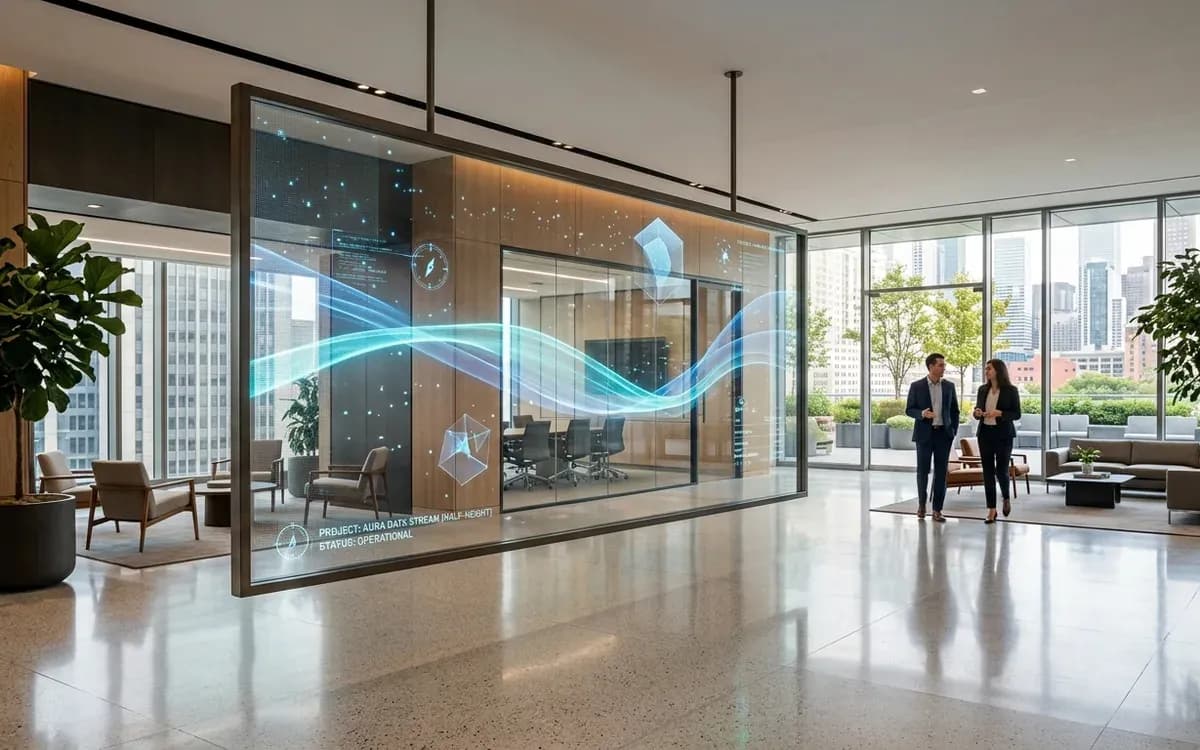
A surface that disappears until you bring it to life.
Designed to integrate into architecture rather than sit in front of it, the Holographic Transparent Screen combines high-impact digital content with a remarkably transparent surface.
When switched off, it reads as glass. When illuminated, imagery appears to float within the space, creating a striking holographic effect without the visual weight of a conventional display.
The technology can be integrated into windows, partitions, balustrades, façades, doors and other architectural elements, opening up possibilities for spaces where a conventional screen simply does not belong.
Use it to add subtle ambient media to an interior, create a dynamic architectural feature, communicate information, or turn an otherwise static glass surface into a living digital canvas.
Designed around the architecture
Transparency, module thickness and panel dimensions can be specified to suit the project, allowing the display to be incorporated into the architectural design from the outset.
The result is a display that can be present without dominating the space: transparent when it needs to be, and visually extraordinary when it comes to life.
What is a holographic transparent screen?
A holographic transparent screen is a display that reads as glass when switched off. When lit, imagery appears to float within the space. It can be built into windows, partitions, balustrades, façades and doors, with transparency, module thickness and panel dimensions specified to the project.